
Last Updated on 27 January 2026 by Massimo M.
Are you a vinyl record collector? Then you are probably interested in knowing how to recognize the original pressings of vinyl records.
Maybe you are one of those who loves everything related to this world, from vintage turntables to decidedly vintage vinyl? If so, you probably already know that the first vinyl record releases have  a much greater value than all subsequent reissues, although these can, in some cases, be qualitatively better. But how do you determine if we are facing a first press? And, above all, how to recognize the original prints of vinyl records?
First of all it must be said that there is no absolutely infallible way to find out if a record is an original vinyl, great importance undoubtedly plays the experience made in the field, but there are certainly methods that can be used to obtain a fairly reliable estimate.
It is also necessary to define, even if it may seem trivial, what is a first print of a vinyl record.
Well, the first print is a record that was, in fact, printed starting from the first original masters. Once the possibility of printing vinyls with the original master is exhausted, we move on to printing with copies of the master and then move on to the second print (second pressing), third print (third pressing) and so on.
Spontaneous question: but why should I be interested in owning original prints of vinyl records
Especially in the years before the commercial relaunch of vinyl records, collectors soon realized that there is a clear difference between the sound and liveliness of the original vinyls compared to some later reissues. But it is not only the prints themselves but also the material used for the reprints and the quantity of the material, that is, even the thickness of the vinyl seems to enter this equation. So, summing up, the original vinyl or first print, call it what you want, represents a sort of guarantee on the “authenticity” of the sound that at the time the artist wanted to record. In addition, there is also economic value. Often, especially in the 60s and 70s, the first prints were made in limited editions for purely economic reasons.
So there are few of them around and, as you know, the more rare a thing is and the more, potentially, it is worth. In addition, many of these prints had errors in the setlists of the songs, labels that changed color, covers printed upside down or with inverted colors and other nice amenities that seem to be made specifically to drive vinyl record collectors crazy (if you want to deepen, by way of example, I recommend you read this article on led Zeppelin IV labels). So, although it is not mandatory, having some original prints in your collection enriches the collection itself from several points of view.
Let’s see how to recognize the original prints of vinyl records
Determine if the record was born to be printed on vinyl or not
Clearly this is a problem that concerns the records released after 1982, the year in which the CD appeared on the market, for the previous ones the problem does not arise!  So one way to determine the possibility that a recording was originally printed on vinyl is to look for information about the release of the record. For example, in the late 90s and early 2000s there was a return of flame towards vinyl and many groups decided for their albums to add, in the second place, to the CD press also that on vinyl. If you find these recordings on vinyl, obviously they are not originals, and, consequently, they have no market value or at least they have it but rather low.
Know when the album was released and from which label
Another thing you can do when it comes to determining if a vinyl record is an original print is to know on what date the album was released. Many albums are also printed several times again after several years have passed  since the first release and this can be confusing. To give an illustrious example, the Beatles’ album, Abbey Road,was originally released on vinyl in 1969 by Apple Records. The vinyl was later re-released in 1995 by Capitol Records. Clearly it is very easy to find the 1995 version of this album but this can in no way be considered an important collector’s item contrary to the 1969 one which is instead very coveted by vinyl record collectors.
Catalogue number and matrix of the original print
You can learn a lot on a record just by considering the catalog numbers attributed to a particular publication. The catalog number, so as not to take anything for granted, is a number that identifies the version of the disc. This attribution, in some cases, is a bit complicated because, for example, many “minor” labels have been incorporated over the years within the so-called majors that have swallowed up the catalog, which has caused a certain overlap of the numbers of the catalog itself. Fortunately, however, there are rather up-to-date online databases that allow you to do even rather complex searches. Once we have determined the catalog number attributed to the original version we have a first useful element to determine the originality of a print. In addition we can also use the matrix number. This number, printed or handwritten, is located on 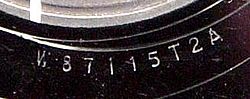 the run-out grooves of the disc and is an alphanumeric combination that is used during the actual production of the disc to distinguish side A from side B. In many cases it is the only really significant data to understand if you are in front of a first press or not.
The matrix or matrix number can be defined as the identity card of the disk.
The problem, however, is that each label has implemented its own coding system so it is very difficult, let’s say impossible, to apply a general rule for reading matrices.In addition, to make the matter more complicated, the coding changes as the country in which the printing is carried out changes. Italian prints, for example, although not all, used a system in which the date of printing was also clearly written. To identify a first print sometimes it is not enough to use the data obtained from the matrix but it is necessary to cross these data with the credits printed in the cover. This is necessary especially for the records produced in the sixties and seventies. These discs, especially those for which a large print run was planned, were printed using several production lines that used several original lacquers (masters) at the same time. From the lacquers were, as usual, obtained father, mother and stamper so, in these cases, if we have a copy that has in the A1 encoding a copy with an A1 it is not said that it is necessarily one of the first copies printed. (if you want to deepen read also the guide “about vinyl records“)
How to read the matrix (example)
For example XEX 579-1 ( Beatles Rubber soul label Parlophone) XEX means, for Parlophone, that the disc is a mono. If it had been stereo there would have been YEX 579 is the reference to the catalog number -1 It is the important part, because it tells us from which print matrix the disc was obtained. In this case the number 1 should ensure that we are in the presence of a first print. However, it should be borne in mind, just to make things even more complicated, that it happened that some matrices were not used to give rise to vinyls intended for sale. It is known for example the case of the first English press of Wish you were here by Pink Floyd which has as its matrix A1 / / B3. Copies with matrix A1//B1 or A1//B2 were not released because the first two matrices used for pressing the second side of the disc were used as test-pressing. In this case, therefore, the B3 indicates, despite the 3 that we are in the presence of a first print. It is therefore absolutely necessary, as you can see, to read up very well especially to avoid being victims of scams.
Make a careful examination of the cover
Keep in mind that even if a disc has the printed catalog number coinciding with the original one and even the same printed release date it is not said that it is an original print. So in addition to what has already been said above it can be useful to carefully observe the vinyl cover because this can also help determine if a vinyl record is an original or not. Each release of the same album has differences from the previous and any subsequent ones. Some of the changes will be very subtle, so difficult to spot, but in many cases, the difference will be noticeable and will concern, for example, shades of colors or, even, modification of the layout. Of course you need to know exactly what the original version of the disc looks like. One last point I think is useful. Although it may seem trivial to some to say, if the album cover has an EAN code (product barcode identification) it means that the album itself was produced after 1973. You will then have in this way an easy element to evaluate the type of print you have in your hands. If you liked this small series of tips I invite you to take a look at the other guides on the site
Mybestreviews.net is not a commercial site but participates in the Amazon EU Affiliate Program, an affiliate program that allows sites to receive an advertising commission from eligible purchases, by advertising and providing links to the Amazon.it site.
As an Amazon Associate, I earn from qualifying purchases.


Leave a Reply