

Last Updated on 27 January 2026 by Massimo M.
Why it is important to know how the turntable works?
 The turntable is the central element of our system intended for reproducing the sounds contained in vinyl records.
So it is important to know how it works, even if only in broad terms, in order to make the best use of this device.
Please note that the audience this article is aimed at is newbies, so we will never get too “technical”, for that there are other sites much more renowned than this one.
So let’s get started!
To better understand how the turntable works, let’s see how it is made by briefly describing the main elements that compose it.
Generally speaking, the turntable consists of:
- a base (plinth), inside which a small motor is housed
- a platter, which is rotated constantly by the motor
- ensemble of tonearm, headshell and stylus.
The base of the turntable is generally made of sound-absorbing plastic material but can also be made with other materials such as aluminum and wood. It is supplied with feet, usually adjustable, which serve to stabilize the turntable as much as possible. The equipment is completed by the platter mat, necessary to prevent the record from slipping during playback, and the transparent cover which helps to minimize the deleterious effects of dust.
On the back of the base there is the power cable to connect to the mains and the cable to connect the turntable to the amplifier.
Here a slightly technical parenthesis must be opened. To be able to listen to the sounds reproduced through the turntable, the signal coming from the turntable itself must be amplified. To do this there are two ways: 1 – buy a turntable with integrated amplifier 2 – buy an unamplified turntable and a separate phono amplifier.
We will talk about the advantages and disadvantages of these two solutions shortly. For the moment, it is enough to know that there is this distinction and that entry and mid-range turntables are generally equipped with an integrated amplifier.
Turntables can also be automatic, semi-automatic or manual. This aspect refers to the management of the head therefore:
with automatic management you press a button and the head places itself at the beginning of the disc and automatically returns to its slot at the end.
In semi-automatic mode if you place the head on the record but at the end of the record itself the arm returns to the base on its own.
With manual mode if you take care of everything.
The difference between these three modes is, to simplify it as much as possible, in the presence or absence of a whole series of more or less perceptible hums, which are inevitably produced using automatic mechanisms and which are minimized with the manual mode.
Finally, turntables can be direct-drive or belt-driven. In direct drive turntables the rotation speed is constant and extremely precise. Much appreciated by DJs because the record starts instantly, it can be read in both directions and there is no resistance at the end of the song.
 However, as regards belt-driven turntables, the movement is produced by an elastic belt connected to the motor which transmits motion to the platter, making it turn. Thanks to this mechanism, background noise is reduced to a minimum, resulting in a better quality sound.
The platter is, in fact, a flat round support. It can be made of both metal and other materials. The disc rests on this support during playback, so it is essential that this element is able to perform a perfectly smooth and constant rotation at 33 1/3, 45 or 78 rpm.
The different rotation speed appropriately selected will allow you to listen to the different available formats of vinyl records.
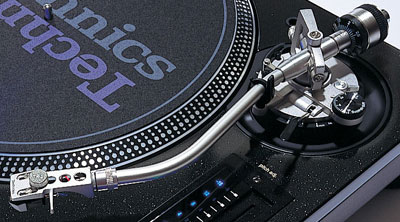 Tonearm and headshell. These are also fundamental elements and a good part of the sound quality of our audio system depends on their quality.
The tonearm is the element of the turntable that allows the head to trace the groove obtained on the surface of the record, following its progress as faithfully as possible. This is necessary to achieve optimal sound reproduction.
The headshell is composed of a housing that contains the stylus. This assembly is the part of the turntable that allows sound to be reproduced.
There are an enormous amount of variations and a specific article would be needed just to classify them all. In principle you can easily use the one supplied with the turntable which will certainly be able to carry out a standard reading.
Having finished describing the composition of a turntable, let’s now move on to understanding how it works
The easiest way to understand how a turntable works is to take any vinyl and look at it closely.
 You will see that the surface of the record is made up of a series of grooves, technically called microgrooves, which spiral towards the center of the record. Each of the grooves traced on the vinyl support has a “V” shape. The needle follows these grooves and vibrates based on imperfections and surface details, generating sound.
As we have already written in a previous article, specifically dedicated to how vinyl records are made , the disk you are looking at is a copy, which was produced from an original disk called a master.
This matrix is used to physically print every single copy of the disc that will be put on the market.
Then, once placed on the record, the needle follows the grooves of the vinyl, transforming the information recorded in the grooves themselves into an electrical signal. This signal, which by its nature is extremely weak and inaudible to the human ear, it is then sent to an integrated or external preamplifier.
The preamplifier amplifies the electrical signal so that it can be sent to an audio amplifier which, in turn, sends it to the speakers or headphones
Stability and balance
After reading what we have written so far on how the turntable works, you will certainly understand that it is a system that requires some precautions to work at its best.
First, vibrations are the enemy of proper audio reproduction. It is therefore necessary that the turntable rests on a perfectly stable surface. It is equally important that the turntable is placed so that it is perfectly level. By using a level and adjusting the height of the feet you can easily achieve the result. Still on the subject of stability, when playing a record that is not perfectly flat (a wavy profile for example), the use of the Clamp can be helpful, to which we have dedicated a specific article.
The exact adjustment of the tonearm, head and stylus are essential to obtain the highest possible fidelity in sound reproduction. There are turntables on the market, suitable for beginners, which have this type of factory preset settings.
In case you still want to try your hand at setting up the tonearm-head-stylus system, I suggest you first read the short guide dedicated to the topic.
Maintenance and cleaning
Always keep the needle and head of your turntable clean. A dirty head can affect sound quality and damage your vinyl. Continue to monitor and clean your turntable regularly. Proper maintenance will help prolong the life of your equipment and ensure high-quality audio reproduction.
For cleaning, use specific tools like these
🙂 By purchasing from these links the price does not change for you, I receive a small contribution that helps me keep MyBestReview alive. 🙏 As an Amazon Associate, I earn from qualifying purchases
 Buy cleaning kit on Amazon
 Buy the vinyl record cleaning machine on Amazon
As an Amazon Associate, I earn from qualifying purchases.


Leave a Reply