

Last Updated on 27 January 2026 by Massimo M.
How to determine if a vinyl is an original produced before the eighties
The guide on how to determine if you own a first pressing of a disc, as it is easy to imagine, is one of the most read guides on this site. Probably because the collector who hides inside each of us hopes
 always managing to make a “coup ” finding a beautiful original First pressing in a cellar or in a trunk in the attic.
So I thought of writing a sort of appendix dedicated specifically to determining the originality of a print produced before the eighties. I know perfectly well that I am not a super expert on the subject, there are an infinite number of people who know much more than me, but this little guide is aimed at those who are now starting to try to put together a collection of vinyl records and I believe that the advice I have put together will certainly be useful.
So how do you determine if you own original vinyl that was made before the 1980s?
Understanding this will be different for each album. But it’s not impossible. It is often quite easy. And I actually think it’s even fun trying to figure it out!
The period is not the best, but it will pass, and we will be able to go back to rummaging in the baskets of the record sellers that are found in practically all the fairs of the world.
So let’s assume we have a copy of a record in hand that we really would like to add to our collection, but only on condition that it is an original pressing.
Keep calm and…
CHECK THROUGH THE INFORMATION ON THE COVER IF THE DISC IS AN ORIGINAL VERSION
 Or use your critical sense. If it is true that it is always possible to find, in reality quite rarely and at very high costs, records from 40 or 50 years ago still in perfect condition, Mint, it is equally true that in all likelihood a record pressed, for example, in the late sixties has been handled several times. So the cover should have some signs of wear. It is a first indication of the “seniority” of the press. I’m talking about “some” wear. If the cover is heavily torn, peeling, and/or shows obvious signs of moisture or mildew, put the disc back where you found it and move on.
EVALUATE THE WEIGHT OF THE VINYL
Even though some vinyls of the sixties/seventies were quite substantial, in terms of weight, very rarely were copies pressed on vinyl of 180 grams and above in those days. Recently, let’s say since vinyl has made a strong comeback in fashion, many reissues of more or less famous albums have been produced using 180 gram vinyl. So if you’re holding a disc of this weight, it’s most likely a modern press.
A BARCODE APPEARS IN THE COVER
 No disk released before 1980/81 has the barcode on the cover. If there is this code, we are certainly in the presence of a modern reprint.
UNEQUIVOCALLY DETERMINE THE CATALOG NUMBER OF THE DISC
While this number by itself may not be that significant, it can still help you determine what kind of press you are holding.
Catalog numbers usually begin with a series of letters followed by numbers and should not change over time. In reality, however, it has often happened that these numbers have changed, due to administrative needs of the labels or also because the entire catalog of the “A” label has been purchased by the “B” label. For example, the US version of Led Zeppelin II originally had the catalog number SD 8236 but after a few years its code changed to SD 19127.
If you have several copies of the same disc available, you can then compare the numbers and see if there are any variations.
The fastest way to verify the catalog number is to use one of the record market specific databases such as Discogs.com or Recordgeek.com. The amount of data stored on these sites is immense, it’s really very rare not being able to find a match.
DETERMINE WHERE YOUR PRINT COMES FROM
It’s always important to know exactly where your vinyl was pressed. Some prints are more sought after than others precisely because they were published in a country other than the artist’s country of origin. For some artists, the Beatles and the Stones above all, there are distinct and separate discographies for records released in the UK and those released in the USA. These records had different track lists and covers.
So having a “foreign” press is always the same as having a sought-after press? Actually not. In fact, it is often the opposite because these versions were made starting from a copy of the original master tapes and not directly from them, so the final result was often a disc with lower audio quality than that of the original album.
CHECK THE RECORD LABEL
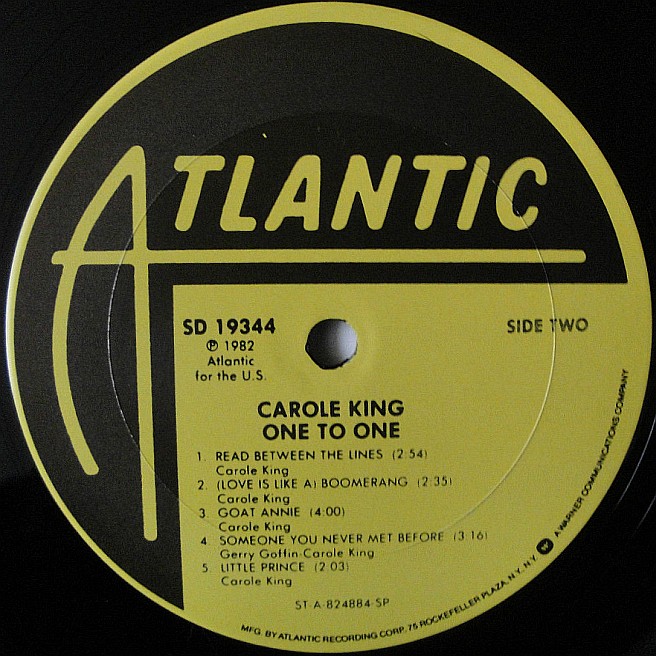 Another element to examine to evaluate your edition of a disc is the central label. Many record companies (for example Reprise) used to use specific labels for the first release and then change from the second pressing on. In other cases, see for example the article published on this site in the Variations of Zoso’s labels of led Zeppelin, the labels of the first printing reported some printing errors or other which were corrected in the second printing.
Furthermore, always in order to determine if you have an original vinyl produced before the eighties, it is also useful to check the indication of the copyright year because, at times, it varied with the change of the pressing number.
Finally, if the label says “mono” you’re pretty sure you’re dealing with an original pressing since mono recordings ended in the late 1960s. But be careful that in the seventies and eighties some discs were produced in mono version, mostly for promotional purposes (Paul McCartney’s RAM and some Stray Cats productions for example).
EXAMINE THE DEAD WAX
The dead wax is the end part of the vinyl, not engraved, which separates the last track from the label. In this area most albums will have inscriptions, printed or hand made, clearly visible. In particular, you will find the matrix numbers, the date the print was made, an indication of whether the print was in stereo or mono and also the catalog number.
Understanding exactly what is written in this area can be tricky because different labels used different markings and catalog systems to indicate what the print was.
 Unfortunately there is no way to be more specific about the information you can find in the dead wax. All of these markings, letters and numbers are unique to your record and to whichever press plant and record label produced it.
As an example, the matrix number may begin with the catalog number of the disc followed by the print number and side reference. So a matrix number could be WXYZ-1234-1-A.
Keep in mind that however the record labels have never adopted a common line and therefore the information you may derive from the dead wax may need further translations.
In any case, Discogs.com comes to our aid again through which it is also possible to find this type of information.
Finally, remember to pay attention if there are hand-engraved or printed initials. In most cases, mastering engineers sign their work because they are proud of it and because they, in turn, have loyal fans who seek out their work. I am thinking, for example, of the works of Alan Parson with Pink Floyd or Robert Ludwig whose initials were engraved in Led Zeppelin II.
I hope I have given you some good advice to feed your collection.
If you have any suggestions, share them in the comments.
As an Amazon Associate, I earn from qualifying purchases.


Leave a Reply